
An interdisciplinary Network to Combat Fusarium Mycotoxin Contamination in Nordic Cereals (LIPFUSA_Nordic)
Coordinator: Amr Kataya, CGB, Department of Agroecology, Aarhus University amrk(a)agro.au.dk
The global occurrence of toxic fungal secondary metabolites (mycotoxins) in edible crops poses a serious threat to agriculture and food safety sectors. Nordic cereals are particularly vulnerable to mycotoxigenic Fusarium species, resulting in significant yield losses and contamination with a plethora of well-known mycotoxins such as deoxynivalenol (DON), nivalenol (NIV), HT-2 and T-2 toxins, as well as emerging mycotoxins such as enniatins. Despite ongoing breeding efforts, cultivars that combine high yield with stable resistance under Nordic environmental conditions remain limited. Achieving such stability requires a detailed understanding of the regulatory layers governing resistance traits, fungal virulence, mycotoxin accumulation, and the strong genotype × environment (G×E) interactions that occur under specific Nordic climatic conditions, such as cool, wet springs.
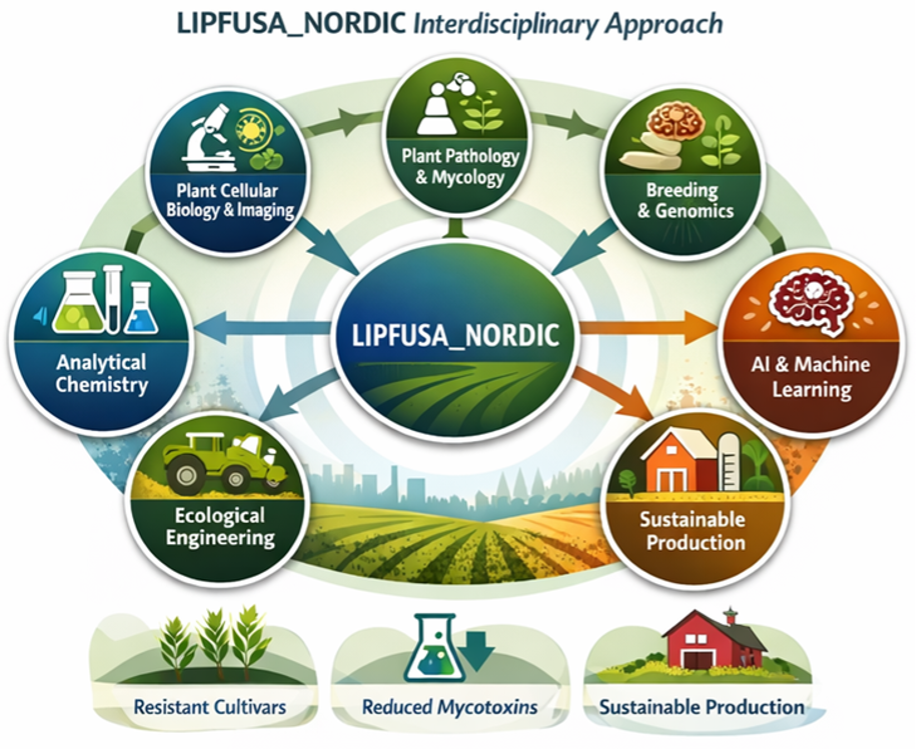
To bridge research on plant and fungal biology, LIPFUSA_NORDIC (LIPid metabolism and FUSarium interactions in Nordic Agriculture) will integrate expertise in plant cellular biology and image-based disease phenotyping, plant pathology, mycology, breeding technology, genomics and AI/ML modeling, analytical chemistry, ecological engineering, and food and feed safety. The network will generate insights essential for developing joint project applications in resistance breeding and integrated strategies to reduce Fusarium infection and mycotoxin accumulation, while also addressing tradeoffs and ecological traits using the complementary expertise of the partners. By identifying key mechanisms driving fungal virulence and in-planta formation of toxins and their masked/modified forms, the network aims to deliver mechanistic insights from molecules to cultivars that are currently lacking but are crucial for predictive, resistance-oriented breeding and sustainable disease management in Nordic cereal production.
The LIPFUSA_NORDIC network involves partners from Denmark, Finland, Norway, Sweden, and Iceland. The LIPFUSA_NORDIC consortium includes: • Aarhus University
• Aalborg University
• Swedish University of Agricultural Sciences
• Swedish Veterinary Agency
• University of Helsinki
• University of Turku
• Natural Resources Institute Finland (LUKE)
• Norwegian Institute of Bioeconomy Research (NIBIO)
• Norwegian University of Life Sciences (NMBU)
• Graminor AS
• Matís ohf. Icelandic Food and Biotech R&D