

According to a study from Stanford University in 2017, 39% of all couples found their partners on the internet, and only 20% “through friends”. What works for people who search for love should also work for those looking for a research collaborator. And in an ongoing pandemic, the internet is more or less the only way of finding that partner. It was therefore natural for SNS and NKJ to make the 2020 Matchmaking Day digital.
Text and photo: Mats Hannerz, Silvinformation

Matchmaking Day is a forum where SNS (Nordic Forest Research) and NKJ (Nordic Joint Committee for Agricultural and Food Research) invite researchers and stakeholders from a broad spectrum of disciplines to identify possible partners and ideas for cooperation. The forum, which has been held almost annually since 2015, was switched this year to a digital platform instead of the usual mingling in person.
Focus on reindeer husbandry
The theme of the Matchmaking Day on August 25 was Reindeer husbandry in the arctic bioeconomy. The original intention was to gather potential delegates at a meeting in Inari, Finland in May 2020. But – the corona epidemic made it impossible.
– We talked a lot about a plan B, says SNS’ secretary Mimmi Blomquist, but we soon realised that the pandemic would continue for a long time, so simply postponing the physical meeting was not an option.
Instead, the meeting was held digitally, led by the facilitator Malin von Essen. Altogether 48 people were present for the full-day event.
Digital possibilities
The meeting was conducted using the Zoom platform, one of several online meeting tools. Skype, Microsoft Teams, Zoom and other services have seen an explosion in users since the pandemic forced people to work from home and avoid travelling. In just the first week from 11-18 March, Teams attracted 12 million new users, and Zoom use increased by 169% during the first months of the year.
– There are hundreds of thousands of people who are now learning how to use video conferencing services in an effective way. The changes we have been talking about for 20 years have now been implemented at record speed, says Malin von Essen.
A new reality
In her business, she moderates and organises meetings and workshops with the aim of inspiring people and taking the results back to their organisations. The meetings are normally physical, but in 2020 she had to rethink the situation.
– We carried out several digital workshops during the spring, and we have learnt a lot about the technique and how to use the potential of the services to engage participants, she says.
The Matchmaking Day was organised as a traditional meeting with lectures, but also with several shorter workshops in smaller groups. The digital platform Zoom facilitates flexible group meetings. In “break-out rooms”, participants with a common research interest could discuss cooperation in a group size allowing more intimate discussions, and the results could be presented later to the entire audience.
– Since we have chat functions and can also assemble suggestions using the menti.com tool, everyone can make their voice heard. And afterwards, other people can look at the recorded presentations and the results of the discussions, all being posted on the SNS’ website.
Content with the outcome
Mimmi Blomquist at SNS was impressed with how well the meeting worked out.
– Of course, we need to meet in person, but this is definitely an option that our research networks could use for many of their workshops. SNS and NKJ provide financial support to research networks with partners from all the Nordic countries, and also neighbouring countries. So, partners are often located thousands of kilometres apart, and we can save lots of travel costs and reduce climate impact by using these digital services, she says.
Advices for your coming digital meetings
It is easy to start a video conference, and most researchers and business people are already used to them, but to make the meetings effective, Malin von Essen has some advice:
- Be clear about your aim and goal – why is the meeting needed and what output do you expect? Then start to think of the content.
- Before the meeting is live, become familiar with all the functions in the digital platform. Conduct a test meeting with some friends.
- Ensure that the meeting will function technically. Not all participants are equally comfortable, encourage them to test the technique in advance. Tell the participants to use a headset and web camera, and to avoid distracting surroundings or strong backlight.
- Schedule breaks in the programme. It is better to have several short breaks than one long one.
Nordic funding opportunities in reindeer research:
The Nordic Committee for Agricultural and Food Research (NKJ) and Nordic Forest Research (SNS) is calling for networks that will strengthen co-operation in reindeer husbandry research in the Nordic region. The applicant must be a researcher or communicator at a research institution. The network must include researchers from at least three Nordic countries.
SNS is calling for networks exploring forests and forestry in relation to reindeer husbandry. The application deadline is September 21, 2020. Apply for SNS networks here!
NKJ prioritises networks focusing on reindeer husbandry in relation to climate change and land-use change, but networks that focus on other aspects of reindeer husbandry are also encouraged to apply. The application deadline is November 20, 2020. Apply NKJ networks here!
SEE THE PRESENTATIONS:
Morten Tryland, professor in veterinary medicine, infection biology at UiT, The Arctic University of Norway, Tromsø
- After a period of clinical veterinary practice, he transitioned to research and has spent most of his research career investigating infectious diseases in arctic wildlife and semi-domesticated reindeer, in close cooperation with Fennoscandian research groups and reindeer herders.
- Morten told us about reindeer health and supplementary feeding, which is a quite complex issue.
Mortens Tryland presentation (PDF)
Jouko Kumpula, senior scientist at Natural Resources Institute (LUKE), Finland.
- He is an animal ecologist and is interested in changes of pastures, reasons for change and how the changes effect reindeer hearding.
Joukos Powerpoint presentation (PDF)
Sirpa Rasmus, researcher at the University of Lapland, Arctic center, Finland.
- She is agefophysicist and is focused on climate impact studies.
- For the last ten years she has been involved in reindeer research, both climate impact research and more general research concerning reindeer.
- She works a lot with other researchers in interdicsplinary
Sirpas Rasmus Powerpoint presentation (PDF)
Åsa Larsson Blind, Chair of Sámiid Riikkasearvi and vice president of Saami Council.
- She lives in Kiruna in the Swedish part of Sápmi.
- She comes from a reindeer herding family in Ran reindeer herding community
She is going to speak about her vision of reindeer husbandry in the arctic bioeconomy.

 For NKJ, cooperation is the key. Therefore we want to gather Nordic testbeds to establish a network that can lead the way towards a sustainable society in a digital future. To facilitate the development of new and existing testbeds, the Nordic Testbed Network aims to unite and strengthen testbeds aimed at supporting the digital transformation of the bioeconomy.
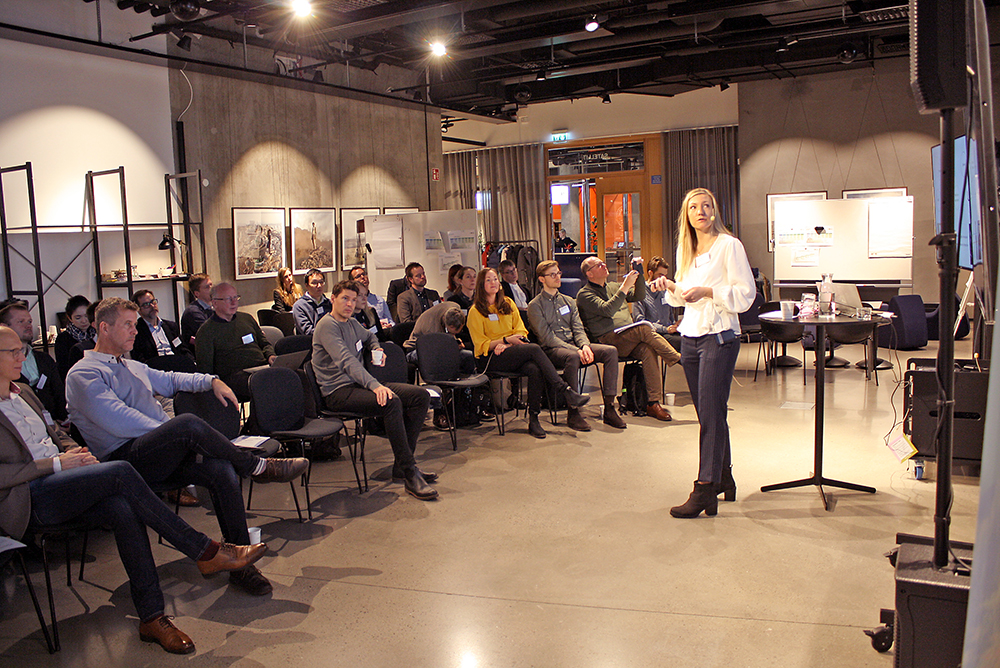 Frida Magnusdotter Ivarsson kick-started the workshop with a very inspiring and energizing talk on the subject “Organizing for digital innovation”, followed by a very interesting talk by Monika Svanberg on “Mobilizing testbeds”. The different testbeds represented at the workshop were also presented with some inspiring talks about how they work to enhance bioeconomy.
 Our special guest this day was Dr Hannes Ottosson, project manager at Innovation Centre Iceland and adjunct lecturer. He teaches innovation and business development at the University of Iceland, and his fields of interest is innovation, entrepreneurship, social capital, social innovation, cluster development and innovation education. He shared his business modell with the researchers at the Matchmaking day, for them to think new when it comes to communication of their knowledge. We heard quite a few positive words about it later on so we thank you so much Hannes for your contribution to the day!
 During the day the participants joined small workshops and were active in developing their dream project and to improve their professional networks. They also acted as mirrors and were of good help in the creative processes for their colleagues. There where also time in the schedule for mingle, so in the evening many new friends and colleagues had found each other.
 In the afternoon we left for a tour by bus to see a small part of Iceland and the Icelandic forests. Our very much appreciated guide A∂alstein Sigurgeirson teached us about the reforestation of Iceland, Icelandic history and a lot more. We ended up around the campfire, chatting and trying some Icelandic specialties.

 Introduced to Lukasz Andrzej Derdowski, who’s also conducting research in the field of work-related creativity, the participants were invited to draw themselves and note their key interests. Pinned to the wall and done relations to the people they already knew participating at the Matchmaking day, this activity resulted in a low-tech social network, which got expanded throughout the whole day.
 The intense networking day ended with a last coffee and mingle while completing the low-tech network to a real piece of art with many new, interesting and helpful contacts for the participants.