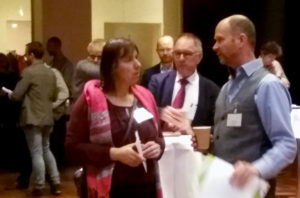
The SNS-NKJ network Neonectria Cankers on trees is having its first meeting february 6th 2018 in Ås, Norway. The outcome of the network activities will be an overview article of the Neonectria cankers in the Nordic countries, and this meeting is a start.
During the day, the participants will hear guest lecturers about Neonectria ditissima, Neonectria neomacrospora and Neonectria fuckeliana. Representatives from the Nordic countries will give a picture of the state of Neonectria cankers in their countries.
The organizers of the meeting have collected photos of Neonectria cankers and reference lists of publications in the participating countries to make an abstract book for the meeting. We look forward to see the book and to hear about experiences of the meeting!
Nina Solheim Flæte will lead the work for strengthening Nordic cooperation in bioeconomy the four coming years. She succeeds Jan Svensson.
The new chairman of NKJ is looking forward to contribute to increased Nordic cooperation in agriculture, food and reindeer sectors.
– NKJ has an important role by contributing to creating meeting places and being an arena for interaction between the national research councils and ministries, Nordic researchers and business actors, she says.
Nina Solheim Flæte wants NKJ to strengthen Nordic cooperation in bioeconomics.
–By uniting fellow players in the Nordic region for joint efforts, we can achieve more sustainable and resource-efficient agricultural and food production.
A major theme internationally, especially after the climate agreement in Paris, is the binding of carbon to agricultural land. Expected changes in the Nordic climate can affect carbon emissions and increase carbon emissions from soil to atmosphere.
The Nordic Council of Ministers sees the need for increased knowledge about the effects of climate change on carbon content in soil, and possible Nordic solutions to maintain or increase carbon content. Among other things, there is a desire to harmonize methodology for modeling and emission calculations that can reveal carbon capture and emissions in Nordic agricultural land that can be used for reporting to the Intergovernmental Panel on Climate Change (IPCC).
– NKJ will lead the work on following up the Council of Ministers’ decision. This is a great opportunity to focus on an important theme and to strengthen cooperation between the Nordic countries in this area, says the new chairman of NKJ.
Nina Solheim Flæte
Background
Nina Solheim Flæte is educated in Norway, at the Norwegian University of Life Sciences. She has a broad background in agriculture, specialized in plant sciences and she has a PhD in baking quality in wheat.
After a period of research, she changed her career to work with management in The Norwegian Agriculture Agency. She was employed at the Research Council of Norway November 1st 2017. At the Research Council she will, among other things, work with the program BIONÆR whose main objective is to trigger research and innovation for value creation in the Norwegian bio based sectors.
NKJ (Nordic Joint Committee for Agricultural and Food Research) makes a call for researcher networks, especially those working with digitization of agriculture.
The focus of the call is on how utilization of digitization can contribute to sustainable management of biological resources, increased competitiveness and reduced climate impact from primary production, but networks can be funded without this focus.
Sweden will lead the work of the Nordic Council of Ministers in 2018. Based on the possibilities of digitization, the Swedish precidency for the agricultural sector will focus on sustainable management of biological resources, increased competitiveness, resilience and reduced climate impact from primary production and diversified rural economics. How can utilization of digitization contribute to increased degree of innovation, more efficient use of biomass and a more resource-efficient agricultural sector?
The network has to have participants from at least three Nordic countries and the main applicant need to be a researcher or communicator at a research institute or research organization. It has to self-finance the activities to an extent of 50%.
Applications must be submitted no later than 12:00 CET on February 28th 2018.
The NKJ and ICT-AGRIs conference ICT and Robotics for a Sustainable Agriculture showed the width and complexity in the process of digitization of agriculture.
Several speakers from a broad variety of companies, research and authorities was invited to the conference. The participants were presented to a variety of projects that aims to digitize agriculture in different ways.
– One of the most interesting sectors in the conference was the use of satellites and what an amazing infrastructure that has been built up in the EU. That anybody today can take part in high tech multispectral satellite data for free is a huge opportunity for European agriculture, says Filip Lundin, Macklean, one of the speakers in the conference.
Gather stakeholders
With the conference, NKJ and ICT-AGRI wanted to illustrate the development in the sector and to create a melting pot where different stakeholders in the process of the digitization could meet, interact and create synergies.
– Above all I think it is important to link private and official stakeholders. Both would have a lot to gain in an increased cooperation, says Filip Lundin about the main contributions in arranging the conference.
Unwilling to take all the risks
He says that private actors often hesitate to invest in new sectors, but with some cooperation and co-financing and sharing of risks with public actors, they would be more than happy to do the investments needed.
IoT, Internet of Things, is a broad term for placing sensors in for example machines, animals or land, sensors that will create data that can be used for developing farming or production of food. The Nordic countries are at the forefront of the development when it comes to research and technology suppliers. The Nordic farmers are generally positive
to change and used to technology and can easily adopt to and learn about the new systems.
Denmark is ahead
Filip Lundin thinks that Denmark has a special position in Scandinavia.
– Above all I think that the Danish universities seem to have come a step further in research and in applying digital solutions, at the same time as the government and authorities put the issue of using digital solutions to increase their competitiveness on the top of the agenda.
A glimpse of the future
In the future, Filip Lundin believe that automation – that is discussed a lot – is more far away than a broader development of Farm Management Systems, that the farmer can control and manage the production with advanced systems
– It is important that stakeholders in the value chain think about the interoperability, that different digital systems can exchange data and cooperate.
New NKJ call soon launched
NKJ will launch a call this autumn with focus on digitization of agriculture. Networking is crucial between countries and stakeholders to spread knowledge and build new knowledge.
– Innovation isn’t only about inventing new things, but to copy and rebuild innovations from other countries and organisations, says Filip Lundin.
– Precision agriculture should be a bigger part of the activity of the universities I think, and in that process this kind of money could be a good start.
See the program and participants here! (link no longer available)
ICT-AGRI Conference on ICT and Robotics for a Sustainable Agriculture will be sent live!
You can have all the presentations right at your desk. It starts on friday 9.30 and ends 16.30.
With the help of digitzing we can improve, streamline and optimize food production to make it grow with decreased loss of resources. This conference in Copenhagen gathers experts from all over the world to engage in the subject.
The conference is arranged by NKJ and ICT-AGRI ERA-NET.
Follow the day here: http://ict-agri.eu/node/38778” (link no longer available)
NKJ will improve the knowledge about agricultural land as a carbon reservoir. The assignment was given from the Nordic ministers in agriculture and food.
The Nordic ministers wants agriculture to help decreasing the emissions of climate gases. Therefor they want to increase the knowledge about how to best use the arable land in that purpose. They also see a need to develop models for measuring carbon in arable land. An important issue is to report and use results from research in the development of future policies for society and advice for practitioners.
NKJ got the assignment to lead the work in close cooperation with the Norwegian chairmanship. NKJ is pleased with the assignment and the work starts urgently.
The NKJ board gathered in Stockholm November 6th to discuss that assignment, but also the coming NKJ calls. Next call will be launched during the autumn and the focus will be digitalization of agriculture. More information will be found on our website, www.nordicagriresearch.org.
The two nextcoming calls was also discussed and the preliminary focuses for them is food safety and animal health.
The chairman of the NKJ board the last four years Jan Svensson, FORMAS, was thanked for his excellent work. Jan Svensson will be replaced at the end of the year by Nina Solhem Flæte from the Research Council of Norway. She comes from the Norwegian Agriculture Agency where she has been a senior advisor, and before that from Norwegian Agricultural Authority and Norwegian University of Life Sciences.
If you are working in Sweden with science, technical development or enterprise in natural resources and biodiversity, you can propose someone to get a scholarship from Carl XVI Gustafs foundation for science, technic and environment.
Konung Carl XVI Gustafs 50-årsfond för vetenskap, teknik och miljö promotes research and enterprising that contributes to sustainable use of the natural resources and conservation of the biodiversity. You can propose individuals, institutions and companies in Sweden. The scholarship is not meant for already well established researchers.
Five or six scholarships of each 85 000-100 000 SEK are granted.
The Swedish market for biological plant protection is too small and needs national support to get access to existing products in other countries.
Researchers in Sweden have evaluated several biological plant protection products. They could show that the effect of the products varied – and that the harvest increased in many cases.
The use of biological plant protection increases in many countries and there are expectations that the chemical plant protection will be replaced with biological alternatives. The researchers wanted to increase accessibility for Swedish plant breeders. But they had a hard time even to get permission from the producers to include their products in the evaluation. The reason is that a small market as Sweden isn’t interesting for them.
The conclusion is that there is a need for national support to be able to provide new and environmental friendly plant protection solutions to the Swedish plant breeders.
And there is an obvious need for more alternatives. The chemical plant protection products is phased out of the EU. That means that the risk for resistance increases.

 The new chairman of NKJ is looking forward to contribute to increased Nordic cooperation in agriculture, food and reindeer sectors.
 The focus of the call is on how utilization of digitization can contribute to sustainable management of biological resources, increased competitiveness and reduced climate impact from primary production, but networks can be funded without this focus.
 With the conference, NKJ and ICT-AGRI wanted to illustrate the development in the sector and to create a melting pot where different stakeholders in the process of the digitization could meet, interact and create synergies.
 Unwilling to take all the risks
 IoT, Internet of Things, is a broad term for placing sensors in for example machines, animals or land, sensors that will create data that can be used for developing farming or production of food. The Nordic countries are at the forefront of the development when it comes to research and technology suppliers. The Nordic farmers are generally positive