Nordic Land Use Conference: Solutions for sustainable land use in the Nordic region

How can we balance the multiple needs of land use in the Nordic region? Nordic Agri Research (NKJ) and Nordic Forest Research (SNS) invite you to a conference where solutions for sustainable land use will be discussed from both research and policy perspectives.

The Nordic Land Use Conference
– solutions for sustainable land use in the Nordic region

Venue: 
The conference venue is the Lecture hall Loftet, at the Swedish University of Agricultural Sciences, in Alnarp. Address: Sundsvägen 6, 234 56 Alnarp, Sweden.
Time: 10-11 December, 2025
Fee: Conference participation is free of charge!


The conference aims to engage researchers, state officials, municipal workers, interest groups, intergovernmental organisations and private land owners from the Nordic region in a dialogue on policy needs related to land use.

The program will begin with a presentation of the report “Changes to Agricultural Land Use in the Nordic Countries – and Future Prospects for Collaboration”, providing an overview of changes in land use and future opportunities for collaboration. This will be followed by keynote speakers who will delve into the conference’s overarching theme.

The conference will then continue with thematic sessions that delve deeper into current issues. These sessions will bring together research projects and policy examples from the Nordic countries, with discussions led by experienced moderators to foster a dynamic and constructive dialogue.

Don’t miss the opportunity to participate in this important conference and contribute to the development of more sustainable land use in the Nordic region!
Call for posters

We are welcoming the scientific community, national agencies, municipalities, NGOs etc to submit a poster for the Nordic Land Use Conference. The aim of the poster session is to showcase initiatives on sustainable land use from the Nordic region and beyond.

The poster can for example showcase a research project, policy development or a development project. Topics of interest include, but are not limited to, the following:

  • Land use and energy production
  • Goal conflict management in land use planning
  • Functional landscapes
  • Spatial tools for land use planning
  • Stakeholder dialogues for sustainable land use

The posters will be exhibited during the conference, and a poster session will be held on the first day of the conference. The poster will also be included in the conference summary report that will be published as an output to the conference.

Authors of accepted posters are expected to print their posters and to exhibit them during the conference. Poster presenters are given a reduced conference fee.

Submission of poster
Submit your proposal for poster in either pdf-format or ppt-format by email to and we will get back to you as soon as possible to confirm its acceptance. Posters must be in standing format, and either of A1 size or 70 cm wide, 100 cm high.
The deadline is passed.


Register here
The conference is free of charge!
Deadline for registration is past.
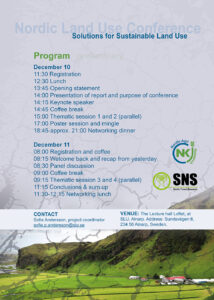

Preliminary program
Day 1
11:15–12:15 Registration
12:15–13:15 Lunch
13:30–13:40 Welcome and purpose of the conference w. Aðalsteinn Sigurgeirsson, president of SNS
13:40–13.50 Results from report on agricultural land use change in Nordic region w. Sofie Andersson and Malin von Essen
13:50–14:20 Keynote w. Henrik Vejre
14:20–14.30 Information on thematic sessions
14:30–15:00 Coffee break
15:00–17:00 Thematic session 1 & 2 (parallel)
17.00–17.15 Conclusions & sum up day 1
17:15–19:00 Poster session and mingle
19:00–approx. 21:00 Networking dinner

Day 2
08:00–08:15 Registration and coffee
08:15–08:30 Welcome back and recap from yesterday
08:30–09:00 Keynote w. Arne Bardalen
09:00–09:20 Coffee break
09:20–11:20 Thematic session 3 & 4 (parallel)
11:20–11:45 Conclusions & sum up
11:45–12:45 Networking lunch

Thematic sessions
Each thematic session will engage the participants in a discussion on solutions and challenges to get there within the chosen topic. The session will begin with 2-3 presentations of best practices, tools and models which will be followed by a workshop.

Thematic session 1
Balancing Solar Energy and Land Use: Policy and Practice in the Nordic Region
Description: This session explores policy development and emerging research related to the expansion of photovoltaics (PV) in the Nordic region. With increasing demand for renewable energy, particularly solar power, land use planning faces new challenges in balancing energy production with other policy goals such as forestry, biodiversity, agriculture, and cultural heritage. The session will highlight guidelines and practical examples of how photovoltaics can be integrated into Nordic landscapes in a sustainable and accepted way.

Confirmed speakers:
Sanna Andersson, Senior Ministerial Adviser, Ministry of the Environment, Finland
”Policy development for regulating solar power expansion in Finland”
Espen Olsen, Professor at the Dep of Physics, Norwegian University of Life Sciences
”Agri-PV: Combining agriculture and solar energy in Nordic countries”

Thematic session 2
Collaborative approaches to functional landscapes I
Description: This session focuses on functional landscapes and the opportunities they offer to combine production, biodiversity, and other land use objectives. It will explore how collaborative approaches – such as stakeholder dialogues – can help balance competing interests, align national and international policy goals, and enhance synergies in land use.
Through examples from the Nordic region, the session will highlight how improved cooperation between stakeholders can support more sustainable and multifunctional landscapes. Case studies will demonstrate how dialogue can serve as a powerful tool to increase acceptance of land use changes, reconcile private and public interests, and foster innovative solutions. The session also considers how successful models and tools can be scaled or adapted to other Nordic contexts.

Confirmed speakers:
Hreinn Oskarsson, Head of department at Land and Forest Iceland
”Stakeholder inclusion and involvement in the Hekluskógar project”
Carina Wettemark, Head of the Unit for Biosphere and Naturum and Coordinator for UNESCO Biosphere Reserve Kristianstads Vattenrike
”Stakeholder involvement for functional landscapes – Biosphere Reserve
    Kristianstads Vattenrike”

Thematic session 3
Spatial tools to support decision- and policymaking
Description: Spatial data, analysis, and modelling offer valuable support for decision-making in complex and multi-layered land use contexts. This session explores how spatial tools can serve as a knowledge base to guide planning and policy development. Key themes include the integration of diverse data sources, practical applications for land use planning, and strategies for user accessibility.

Confirmed speakers:
Benjamin David Henning, Professor of Geography at the University of Iceland
”Participatory mapping platform for ecological restoration of the Icelandic highlands”
Moritz Kaiser, M.Sc. at Michael Succow Foundation, Partner in the Greifswald Mire Centre
”The European wetland map”
Gunnhild Søgaard, Head of Department Forest and Climate, Norwegian Institute of Bioeconomy Research (NIBIO)
”Map-based greenhouse gas calculator for spatial planning purposes”

Thematic session 4
Collaborative approaches to functional landscapes II
Description: This session focuses on functional landscapes and the opportunities they offer to combine production, biodiversity, and other land use objectives. It will explore how collaborative approaches – such as stakeholder dialogues – can help balance competing interests, align national and international policy goals, and enhance synergies in land use.
Through examples from the Nordic region, the session will highlight how improved cooperation between stakeholders can support more sustainable and multifunctional landscapes. Case studies will demonstrate how dialogue can serve as a powerful tool to increase acceptance of land use changes, reconcile private and public interests, and foster innovative solutions. The session also considers how successful models and tools can be scaled or adapted to other Nordic contexts.

Confirmed speakers:
Sara Vangerschov Iversen, Ph.D Landscape Ecologist and Tenure Track Assistant Professor at Center for Sustainable Landscapes under Global Change, Aarhus University
”Understanding human values in the implementation of multifunctional landscapes in Denmark”
Emma Luoma, Leading specialist at Akordi
”Platform for reindeer husbandry and wind power in Finland”

How to get there
When travelling abroad by plane, it is recommended to fly to Copenhagen airport Kastrup. From the airport to the venue you can take the train directly from the airport to Burlöv station and from there take the bus to Campus Alnarp. You can buy your train/bus ticket in the Skånetrafiken machines at the airport or in the Skånetrafiken app.

Organisers
Nordisk Kommitté för Jordbruks- och matforskning (NKJ) and SamNordisk Skogsforskning (SNS), funded by the Nordic Council of Ministers

Background
During the Nordic Committee of Senior Officials for Fisheries, Aquaculture, Agriculture, Food and Forestry (EK-FJLS Agriculture and Forestry) meeting in Hardanger in April 2022, land use conflicts related to food production and agricultural land were discussed. The committee members recognised that agricultural and arable land is a limited resource, and that strategies and political guidelines to limit agricultural land loss and ensure food security while also ensuring that other national needs are met differ among Nordic countries. Following this discussion, Nordic Agri Research (NKJ) and Nordic Forest Research (SNS) were assigned to provide the committee with further knowledge on the situation of agricultural land and how agricultural land use disputes are handled in the Nordic countries. The results from this report form the foundation for this conference.

Land under pressure – growing demand for farmland

The area of agricultural land has long been decreasing in the Nordic countries. Farmland is now expected to serve many purposes beyond just food production – and it is urgent to discuss how we can collectively manage the conflicts that arise.

Svensk text: scrolla ner


Over the past decade, food production has been strained by multiple crises. The COVID-19 pandemic, climate change, war, and inflation all affect how we manage our land. This has made it an increasingly urgent issue to discuss and find answers to – both globally and at the Nordic level.

– For the future, we need to reflect on the role that agriculture and agricultural land play in times of crisis, and how the green sector can prepare to handle such crises, says Sofie Andersson, project coordinator at Nordic Agri Research (NKJ).

But it’s not only different types of crises that affect the food system. More and more new interests are placing demands on land as a vital resource. We want to create green energy, build housing, and protect biodiversity – just a few examples of land-intensive activities. Clearly, we need discussion and new solutions to meet all these needs.

Nordic Agri Research (NKJ) is now engaging in this discussion and offering recommendations for future cooperation on land use issues. The Nordic countries have a long tradition of collaborating to solve shared challenges. Tackling land use issues and balancing society’s various needs while maintaining national food security is no exception – and is facilitated through increased Nordic exchange.

– Competition for agricultural land creates both local and national conflicts. Through collaboration between the Nordic countries, we can help resolve these conflicts more effectively and quickly than we could individually, says Sofie Andersson.

The Nordic countries share similarities and differences in how they manage land use. They have similar planning systems, where local authorities hold the main responsibility, but differ in the types of national policy tools used to influence or regulate local planning. There is a lot they can learn from each other. In some areas, a common knowledge base would also facilitate cooperation in crisis management – for example, the development of soil maps for potential arable and pasture land, and common definitions of soil quality.

See all recommendations, statistics, and facts on land use in the Nordic countries


Swedish text:

Jordbruksmark under press – fler och fler avgörande behov kräver tillgång på mark

Arealen jordbruksmark har länge minskat i de nordiska länderna. Idag förväntas åkermark fylla många fler syften än enbart matproduktion – och det är brådskande att diskutera hur vi gemensamt kan hantera de konflikter som uppstår.

Under det senaste decenniet har livsmedelsproduktionen satts under press av flera olika kriser. Covid-19-pandemin, klimatförändringar, krig och inflation påverkar hur vi använder vår mark. Därför är det nu mer angeläget än någonsin att diskutera dessa frågor – både globalt och på nordisk nivå.

– För framtiden behöver vi reflektera över vilken roll jordbruket och jordbruksmarken spelar i krissituationer, och hur den gröna sektorn kan förbereda sig för att hantera sådana kriser, säger Sofie Andersson, projektkoordinator på Nordic Agri Research (NKJ).

Men det är inte bara olika typer av kriser som påverkar livsmedelssystemet. Allt fler nya intressen ställer krav på marken som resurs. Vi vill skapa grön energi, bygga bostäder och skydda biologisk mångfald – bara några exempel på markkrävande verksamheter. Det är tydligt att vi behöver diskussioner och nya lösningar för att möta alla dessa behov.

Nordic Agri Research (NKJ) engagerar sig nu i dessa frågor och presenterar rekommendationer för framtida samarbete kring markanvändning. De nordiska länderna har en lång tradition av att samarbeta för att lösa gemensamma utmaningar. Att hantera markanvändning och balansera samhällets olika behov, samtidigt som den nationella livsmedelssäkerheten tryggas, är inget undantag – och det underlättas av ett ökat nordiskt utbyte.

– Konkurrensen om jordbruksmark skapar både lokala och nationella konflikter. Genom samarbete mellan de nordiska länderna kan vi lösa dessa konflikter mer effektivt och snabbare än vad länderna kan var för sig, säger Sofie Andersson.

De nordiska länderna har både likheter och skillnader i hur markanvändningen hanteras. De har liknande planeringssystem, där det huvudsakliga ansvaret ligger på lokal nivå, men skiljer sig åt i vilka nationella styrmedel som används för att påverka eller reglera den lokala planeringen. Här finns mycket att lära av varandra. Inom vissa områden skulle en gemensam kunskapsbas också underlätta samarbete vid krishantering – till exempel genom utveckling av jordartskartor över potentiell åker- och betesmark, samt gemensamma definitioner av markkvalitet.

Se alla rekommendationer, statistik och fakta om markanvändning i de nordiska länderna här

The healing power of nature: an opportunity for rural entrepreneurship

For thousands of years, people have turned to nature for healing, recovery and remedies. Even today, nature can be an important source of health in the modern society. To promote wider use of Nature-Based Health Interventions (NBHIs), the Bioeconomy Programme has released a set of materials.


The material consists of a report with insights and policy recommendations, and a booklet with good practice examples.


The report maps nature-based health interventions (NBHIs) status in the Nordic-Baltic region as well as identifies challenges and provides policy recommendations. The recommendations are meant to unlock the full potential of NBHIs. One of the recommendations is to arrange scientific studies, to find out facts about how natural resources affect human health. It also proposes the funding of research on the economic aspect of NBHIs in the public sector and in rural areas.

– With the help of the research, we would be able to identify areas within the public sector where this kind of intervention could reduce pressure on existing healthcare services, says Bioeconomy Programme coordinator Anna Meisner Jensen.

If NBHIs are to be included in public healthcare, it’s important to be sure that the interventions have real effects. Therefore, it is proposed to set up national definitions and regulations for all NBHI activities to ensure consistency and efficacy in the implementation of them.

– That way, national plans could be developed to include NBHIs in public services, says Anna Meisner Jensen.

Another important part highlighted by the report is the need to spread knowledge about the benefits of NBHIs. Decision-makers in areas such as social services and the education system must gain access to knowledge about NBHIs and how they can be used.

– It would be good to develop materials on NBHIs that specifically target decision-makers in the right positions, so that we have the tools to reach out, says Anna Meisner Jensen.


Complementing the report is a practitioner-oriented booklet detailing business models, profiles, and practical insights. The booklet is designed to inspire current and future practitioners by showcasing diverse examples of nature-based health interventions (NBHIs).

Developed with current and future practitioners in mind, the booklet presents insights and examples demonstrating how landowners and small businesses in rural areas are integrating NBHIs as an income source. This booklet highlights the current role of NBHIs, shares practitioners’ challenges, and provides examples of successful models for those interested in or currently practicing NBHIs. It aims to provide guidance and inspiration for stakeholders looking to harness the potential of NBHIs and illustrate how the spread of NBHI practices can enhance public health while providing economic opportunities for rural communities.

Together, the report and booklet form a comprehensive resource material to encourage the development and adoption of NBHIs across the region.


Definition: Nature-based health interventions (NBHI)

Deliberately designed activities aimed at enhancing individuals’ overall functioning, health, and well-being, or aiding in their recovery and restoration by engaging with or being exposed to nature. In this context, the term ”nature” includes natural environments shaped by humans.


Bioeconomy program
SNS and NKJ got the mission from the Nordic Council of Ministers to start the work towards growth and green transition in Nordic and Baltic rural areas, with bioeconomy as the driver. We have run the Bioeconomy program during five years. The main objectives have been to:

  • Strengthen sustainable use of available bioresources in Nordic/Baltic rural areas.
  • Increase economic growth and social sustainability in rural areas in the Nordic and Baltic.
  • Strengthen Nordic/Baltic industry competitiveness in bioeconomy sectors in rural areas.

Knowledge exchange crucial for addressing bioenergy challenges

Identification of successful integrated local solutions for knowledge sharing is considered important when addressing the major challenges in the bioenergy sector. The Bioeconomy Programme has worked together with stakeholders and researchers to develop policy recommendations.

Download the report


A newly published report builds on the recommendations outlined in the Bioenergy Scoping Paper commissioned by the Nordic Council of Ministers in 2023. The primary objective of the report has been to ensure that the scoping paper policy recommendations can be implemented with lasting impact. Additionally, the report aims at deepening the understanding of the bio­energy value chain context and provide ac­tionable input by identifying relevant challenges and po­tential solutions.

Four seminars were organized, aiming at capturing the main points of view and feedback on the recommendations in the 2023 scoping paper, of four key groups: researchers, bioenergy organisations, practitioners and policymakers. The findings from the 2023 scoping paper were discussed, and the recommendations were further refined and classified in order of priority (see below).

The four policy recommendations address the major challenges facing bioenergy in the Nordic-Baltic region. While they can be implemented individually, they are also designed to complement each other. The seminar participants ranked them in this order:

  1. Identifying successful integrated local solutions for knowledge sharing – Recognizing and disseminating effective local bioenergy initiatives to support broader adoption.
  2. Creating a Nordic-Baltic cooperation platform on bioenergy – Establishing a collaborative framework to promote cross-border partnerships and knowledge exchange.
  3. Mapping existing regional networks and initiatives – Identifying current bioenergy networks to leverage synergies and avoid redundant efforts.
  4. Organizing Nordic-Baltic hackathons – Hosting innovation-driven events to tackle specific bioenergy challenges and inspire creative solutions.

Do you want to learn more about how these recommendations can be put into practice? Download the full report – it’s free of charge! You’ll find concrete proposals on how to implement these ideas and reach the intended goals, as well as insights into the methods used to develop the recommendations.

How the Nordic Baltic regions can manage the challenges in plant nutrition supply

The Nordic bioeconomy faces significant challenges in securing access to plant nutrition. To address these issues, the Bioeconomy Programme, led by Nordic Agri Research (NKJ), Nordic Forest Research (SNS) and funded by the Nordic Council of Ministers, has published a new report.

The report maps ongoing initiatives, identifies key challenges, and proposes preliminary policy measures to ensure a stable and sustainable plant nutrition supply in the Nordic and Baltic regions.

Background of the report

Global food production depends heavily on a stable supply of plant nutrition. Disruptions in this supply chain can have severe consequences for food security. Against this backdrop, the Bioeconomy Programme initiated a study to:

  • Map ongoing initiatives and activities aimed at securing plant nutrition supply in the Nordic and Baltic regions.
  • Identify risks and challenges associated with these initiatives.
  • Propose preliminary policy actions to strengthen self-sufficiency and reduce vulnerabilities.

Key findings and conclusions

The report reveals that several promising initiatives are under development, particularly in Sweden, with the potential to significantly reduce reliance on imported plant nutrition. These initiatives vary in scale and timeframe, with some already in production and others planned to launch before 2030.

Despite these positive developments, the report identifies several key challenges:

  • Uncertainty about future demand: Producers express concerns about whether consumers are willing to pay for fossil-free but potentially more expensive products.
  • Dependence on imported raw materials: Many initiatives rely on imported inputs, which can create vulnerabilities during global supply disruptions.
  • Access to green electricity: The increased demand for renewable energy may lead to bottlenecks, particularly in northern Sweden, where many projects are concentrated.
  • Regulatory barriers: Existing legislation and permit processes are often not adapted to new and innovative technologies, causing delays in implementation.

Recommended policy actions

To address these challenges, the report suggests several policy measures:

  • Establish common goals and strategies: Develop a unified vision for plant nutrition supply in the Nordic and Baltic regions.
  • Introduce economic incentives: Provide subsidies for fossil-free production and/or taxation on traditional, more environmentally harmful methods.
  • Reform regulations: Adapt legislation and permit processes to facilitate the implementation of new technologies.
  • Create networks and platforms: Promote collaboration among key stakeholders through Nordic/Baltic networks for knowledge exchange and joint development.

By implementing these measures, the Nordic and Baltic countries can strengthen their self-sufficiency in plant nutrition, reduce vulnerabilities to global disruptions, and foster a sustainable bioeconomy in the region.

For more detailed information, you can access the full report here.

CANCELLED: Nordic Conference on the Challenges of Land Use

THE CONFERENCE IS CANCELLED UNTIL FURTHER NOTICE


How can we balance the multiple needs of land use in the Nordic region? Nordic Agri Research (NKJ) and Nordic Forest Research (SNS) invite you to a conference where challenges and opportunities in land use will be discussed from both research and policy perspectives.

The Nordic Land Use Conference
– solutions for sustainable land use in the Nordic region

Place:
Hótel Varmaland, Borgarnes, Iceland
Time: May 7, 2025
Programme: scroll down


The conference aims to engage researchers and civil servants in a dialogue on national policy needs related to land use. Therefore, participants from the political sector, research organizations, and other relevant stakeholders are welcome.

The program will begin with a presentation of the upcoming report “Changes to Agricultural Land Use in the Nordic Countries – and Future Prospects for Collaboration”, providing an overview of changes in land use and future opportunities for collaboration. This will be followed by keynote speakers who will delve into the conference’s overarching theme.

The conference will then continue with thematic sessions that delve deeper into current issues. These sessions will bring together research projects and policy examples from the Nordic countries, with discussions led by experienced moderators to foster a dynamic and constructive dialogue.

Don’t miss the opportunity to participate in this important conference and contribute to the development of more sustainable land use in the Nordic region!


Register here THE CONFERENCE IS CANCELLED UNTIL FURTHER NOTICE
 
Registration fee is 1.500 SEK and includes lunch, conference refreshments and a three course dinner.

Target group
Developers or owners of concrete examples within the themes and current and potential users of them (this includes researchers, state officials, municipal workers, interest groups, intergovernmental organisations and private land owners, primarily in the Nordic region).


Preliminary program:

09:00–09.30 Registration

09:30–09:45 Opening statement

09:45–10.00 Presentation of report and purpose of conference

10:00–10:45 Keynote speaker 1

10:45–11.00 Coffee break

11:00–11:45 Panel discussion: The role of land use planning in preparedness

12.00–13.00 Lunch and networking

13.00–15:00 Thematic session 1 & 2 (parallel), see information below

15:00–17:00 Thematic session 3 & 4 (parallel) see information below

17.15 – 17.45 Conclusions & sum up

18:30 Networking dinner


Thematic sessions
Each thematic session will engage the participants in a discussion on solutions and challenges to get there within the chosen topic. The session will begin with 2-3 presentations of best practices, tools and models which will be followed by a workshop.

 Thematic session 1
Managing conflicting policy goals in land use management – Energy production

Description: The first two sessions will look into different tools, models and conclusions made from different parts of the Nordic region on how to handle conflicting policy goals and how various considerations and land-use interests can be balanced. This session will specifically focus on photovoltaics, how they can co-exict within landscapes, strategies and guidelines for handling the increased demand for photovoltaics.

Thematic session 2
Managing conflicting policy goals in land use management – functional landscapes

Description: The first two sessions will take a look into different tools, models and conclusions made from different parts of the Nordic region on how to handle conflicting policy goals and how various considerations and land-use interests can be balanced. This session will specifically focus on functional landscapes, for example the potentials of increasing biodiversity within a production landscape and steering instruments to prioritize between different national and international policy goals.

Thematic session 3
Spatial tools to support decision- and policymaking

Description: Spatial data, analysis and models can offer knowledge foundation to make decisions in high complexity situations. This session includes how to meet the challenge of data security, potentials of combinations of spatial data and sources and investigating how the establishment of the EU soil monitoring can be utilized for land use planning.

Thematic session 4
Multistakeholder dialogues in land use planning

Description: Dialogues can serve as a powerful tool to balance private and public interests in land use and to increase acceptance for land use changes amongst actors within a landscape. Improved cooperation between different stakeholders can also increase the likelihood that synergies in land use are exploited. This session explores local examples of stakeholder dialogues in the Nordic region and looks into the results and key learnings of them, to ultimately consider how these models and tools can be scaled or transferred to other parts in the Nordic region.


Organisers
Nordisk Kommitté för Jordbruks- och matforskning (NKJ) and SamNordisk Skogsforskning (SNS) / funded by the Nordic Council of Ministers


Background
During the Nordic Committee of Senior Officials for Fisheries, Aquaculture, Agriculture, Food and Forestry (EK-FJLS Agriculture and Forestry) meeting in Hardanger in April 2022, land use conflicts related to food production and agricultural land were discussed. The committee members recognised that agricultural and arable land is a limited resource, and that strategies and political guidelines to limit agricultural land loss and ensure food security while also ensuring that other national needs are met differ among Nordic countries. Following this discussion, Nordic Agri Research (NKJ) and Nordic Forest Research (SNS) were assigned to provide the committee with further knowledge on the situation of agricultural land and how agricultural land use disputes are handled in the Nordic countries. The results from this upcoming report form the foundation for this conference.

Hackathons can help fill the future need for bioenergy

The Nordic-Baltic region faces urgent challenges in reducing CO2 emissions, requiring a joint effort towards sustainable energy solutions. Leveraging bioenergy solutions emerges as a key strategy to meet emission goals. It offers the potential to diminish reliance on fossil fuels across various sectors including heating, electricity generation, and transportation.

Text: From the report “Bioenergy – Knowledge transfer in the Nordic-Baltic region for increased uptake of sustainable bioenergy”


Find the report


Commissioned by the Nordic Council of Ministers and supported through the Bioeconomy programme, this scoping paper delves into the intricate landscape of bioenergy innovations within the region. Employing a mixed-method approach combining desktop research and interviews, the study identifies opportunities for further knowledge transfer activities in the Nordic-Baltic region.

A technology neutral approach is vital for knowledge exchange activities as highlighted by experts included in the study. The interviews moreover led to the following observations:

Current biomass challenges are directly linked to geopolitical conflicts

Bioenergy has to rely on by-products, low value biomass and waste

Bioenergy innovations are required to be flexible

Regional areas of excellence provide opportunity for knowledge sharing

Nordic-Baltic strongholds lie in integrated systems of bioenergy solutions

Nordic-Baltic experts would benefit from a cooperation platform and regional funding

Universities are a useful meeting place for experts to build solutions for local contexts

The Nordic-Baltic region gathers a wealth of expertise and industry interest in biomass use for energy production. Additionally, the region showcases various integrated system solutions for bioenergy—knowledge that could be applicable to other areas lacking such comprehensive approaches. This context provides a fertile foundation for fostering regional knowledge exchange and facilitating the adoption of innovative practices. Yet, amidst geopolitical uncertainties and fluctuating markets, the need for adaptability and flexibility in bioenergy strategies becomes apparent.

In response to these findings, a series of recommendations are proposed for further knowledge sharing activities:

Facilitating industry and academy interactions via a Nordic-Baltic cooperation platform

Supporting existing networks active in the region

Creating a Nordic- Baltic call to promote regional cooperation

Identifying successful integrated local solutions for knowledge sharing

Involving tomorrow’s talents: organisation of Nordic-Baltic hackathons

Recommendations to strengthen the Nordic bioeconomy

Expanded Nordic cooperation is the key to creating a more resilient bioeconomy, especially in the wake of polycrises. NKJ and SNS can now present a policy brief with recommendations to strengthen and develop the Nordic bioeconomy.


The basis for the recommendations are desktop studies of Nordic initiatives on crises management and resilience, and multiple dialogues with experts from the Nordic bioeconomy.

Addressing the challenges of one crisis, let alone multiple crises affecting the region simultaneously, requires coordinated efforts. Many different perspectives must be taken into account and how the different countries’ bioeconomies work must be clear.

The potential for more joint Nordic efforts to strengthen the resilience of the bioeconomy looks promising. The countries have similar social structures and topographies, there are already companies operating throughout the region, similar political ambitions in, for example, climate measures and existing networks and initiatives create good conditions for Nordic cooperation. It has also been shown that there is a strong interest in jointly meeting the challenges associated with crisis preparedness and crisis management in the bioeconomy.

This policy report presents five policy recommendations. Nordic decision-makers and stakeholders can enable effective progress towards a more resilient Nordic bioeconomy by:

1 Developing a joint roadmap for a resilient Nordic bioeconomy

2 Strengthening the resilience in the Nordic -bioeconomy value chains by identifying and addressing critical dependencies

3 Enabling an efficient, accessible, and safe -sharing of high-quality bioeconomy data across the Nordic region

4 Supporting knowledge sharing between Nordic crises communication functions

5 Integrating the recommendations for a more -resilient Nordic bioeconomy in the development of the Nordic Cooperation Program for 2025-2030


Read more details about the recommendations, and download the policy brief here

New nutritional recommendations for both health and the environment

The new nutrion recommendations are not only guidelines for better health for humans, but also link health with the health of the planet.


In order for our food to be useful and sustainable for the future on Earth, we must eat less meat, and more fish and vegetables. That is the conclusion formulated in the new Nordic nutritional recommendations 2023 which are just launched. The recommendations are based on the best available science on food consumption, health, and the environment and shows that human health and sustainability goes hand in hand.

The nutrition recommendations are the result of four years of hard work by a project group within the Nordic Council of Ministers and lots of researchers and others engaged. The report provides a shared evidence-based foundation which assists the countries in developing dietary guidelines, but also receives international attention.

The new recommendations have changed on a number of points compared to the previous edition.

See what changes have been made to the nutritional recommendations

Find the Nordic nutritional recommendations 2023 here

NKJ report on challenges for reindeer husbandry in the Nordic region

Recently, NKJ arranged a conference on challenges for reindeer husbandry in the Nordic region. The conclusions from the conference and an overall view of the state of reindeer husbandry in the Nordic countries are now available in a report.


The topic of the 2022 conference was challenges to reindeer husbandry, in particular the impact of predators, as well as consequences of a changing climate in Sweden, Finland and Norway. The conference contained four parts: Part 1: Loss of reindeer to predators, Part 2: Governance, Part 3: Ongoing research projects and Part 4:  Reindeer husbandry in a changing climate. The report gives a summary of the presentations and discussions in each part.

The report also gives a long list of key take-aways from the conference. The importance of synthesis between traditional and scientific knowledge is one of the twelve points in the list. Download the report (below) to see all of the messages the participating researchers, authorities, organisations and stakeholders underline.

The Nordic Conference on Reindeer Husbandry was arranged 9-10 November 2022 at NIBIO Svanhovd, Pasvik, Norway.

Download report

See the recorded presentations from the conference